I don't remember agreeing to that.
Two bits of news, then the useful bit.
Book of the year
Project management educator Mike Clayton named Just F*cking Ship It his book of the year. His review is called "This book ships it — magnificently", and his summary is better than anything I'd write about my own book: "Buy it, read it, just f*cking implement it." Read Mike's review

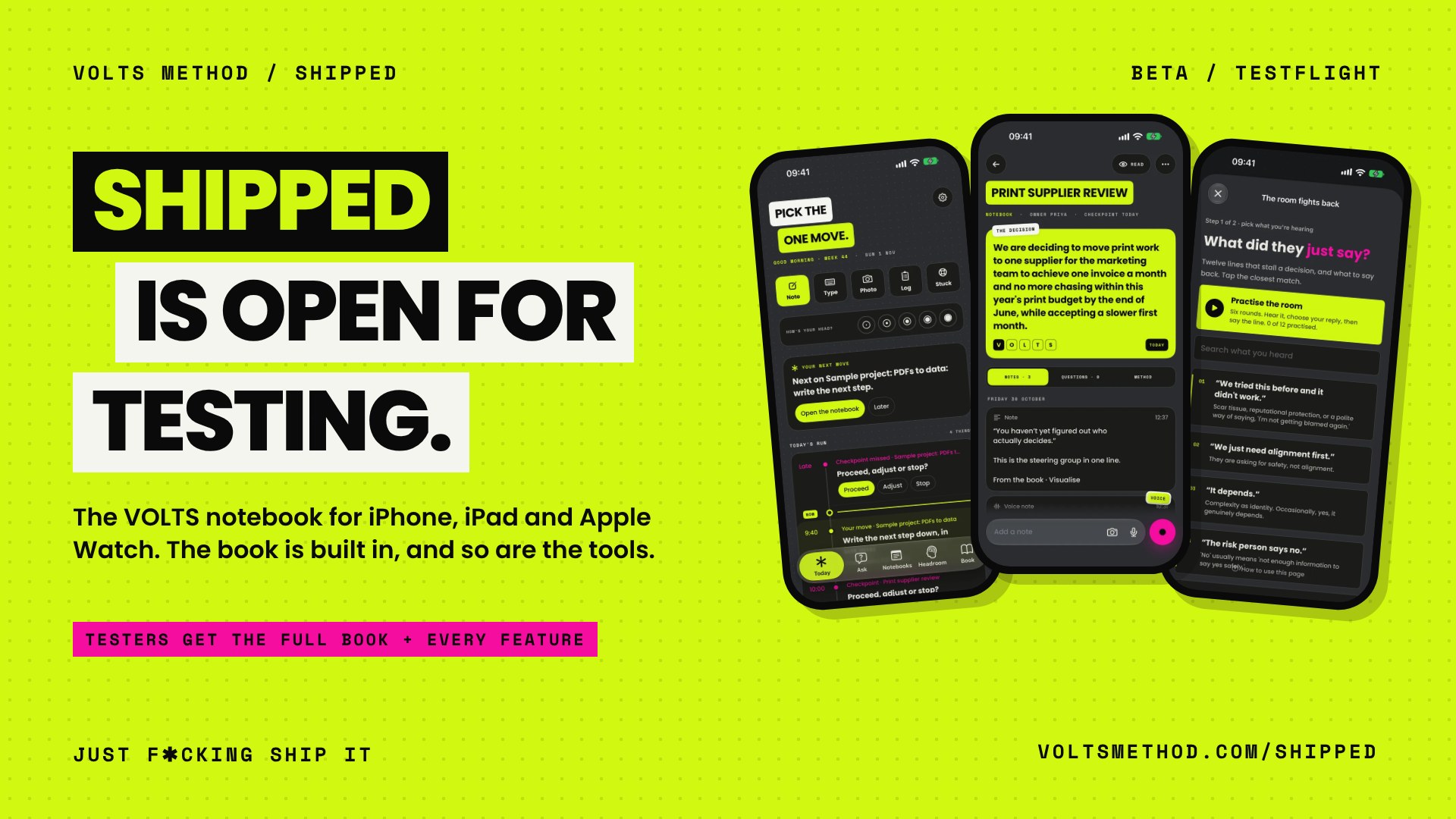
Shipped is open for testing
Shipped is the VOLTS notebook app for iPhone, iPad and Apple Watch. One notebook per piece of work, with the decision on the cover. The book is built in, and so are the tools. It's in beta on TestFlight, and testers get the full book and every feature unlocked. Open this link on your iPhone to join: join the Shipped beta
It's a beta, so things will break. When they do, reply and tell me.
Now, the useful bit
Three months in. Steering group. Someone senior leans back and says it.
"I don't remember agreeing to that."
Nobody's lying. That's the uncomfortable bit. They genuinely don't remember. The decision was made on a Tuesday call, half the room was on mute, the actions went into somebody's notebook, and the reasoning went nowhere at all.
So now you're not delivering. You're relitigating. The work stops while six people reconstruct a conversation from memory, and memory is a terrible project manager. It edits. It flatters. And it drifts, very reliably, towards whoever is most senior in the room.
Nobody's lying. They just don't remember. That's worse.
The tell
Ask your team to show you where last month's three biggest decisions are written down. Not discussed. Written down. With who owns them and what was traded away to make them.
If the answer involves searching Slack, forwarding an email chain, or "it's in the minutes somewhere", you don't have decisions. You have recollections.
The fix: one line per decision
A decision log. Not a governance artefact. Not a RAID log with a new tab. One line, every time something is decided:
- Date
- The decision, as one sentence the room could repeat
- One owner. A person, not a team
- The boundary: what's in, what's out
- The trade-off you accepted
- The proof point, and what would make you look at it again

Six fields. Two minutes at the end of the meeting.
The trade-off column does most of the work. Every real decision costs something. If the log never says what, the decision will be reopened by whoever lost.
The VOLTS move
It starts with Visualise & Align: the first field is a Decision Sentence, one line the room can repeat back accurately. The log is what keeps that sentence true after everyone has left the room. When someone says they don't remember agreeing, you don't argue. You open the log.
Free: every template from the book
This week the book's toolkit moved onto the new voltsmethod.com, and every worksheet now has its own page. Type into the boxes and the copy-ready version writes itself. No sign-up. Nothing leaves your browser.
The one from this issue: the decision log template
The rest, including the five-beat stakeholder update, the proof plan, the bad-news update and the email that corrects the record: the book toolkit
One thing to try this week
At the end of your next meeting that decides something, stop two minutes early. Write the log line together, out loud.
If the room can't agree on the trade-off column, you haven't finished deciding. Better to find that out on Friday than in month three.
The VOLTS Dispatch: tactics for product and delivery leaders who are done with meetings that produce activity but no decisions.
Sign up by emailRead the book